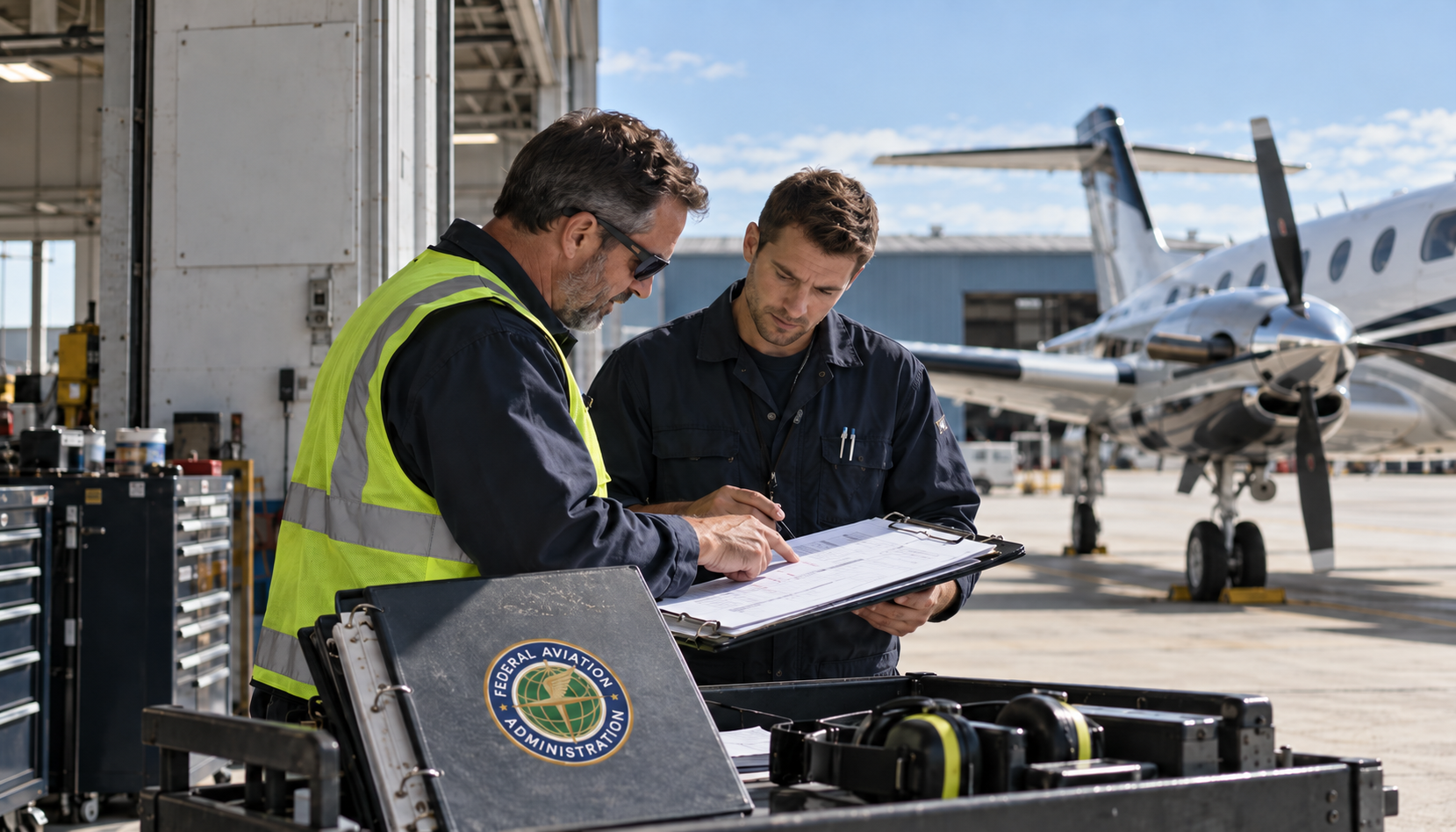
For an FAA-certificated repair station, Part 145 defines much more than the path to obtaining a certificate.
It establishes an operating framework for the people, facilities, equipment, manuals, quality systems and records behind the maintenance work the station is authorized to perform.
A Part 145 certificate establishes the repair station and its approved scope, but maintaining that status depends on repeatable processes after certification.
Personnel change. Capabilities expand. Manuals are revised. Equipment requires calibration. Training records accumulate. Maintenance may need to be performed away from the station’s fixed location.
Each of those changes creates information that needs to remain controlled.
This guide explains the FAA Part 145 certification process and the compliance areas repair stations should continue managing once the certificate is issued.

14 CFR Part 145 contains the certification and operating rules applicable to FAA-certificated repair stations.
A repair station operates according to its certificate, operations specifications and approved ratings.
Under §145.59, ratings may cover areas such as airframes, powerplants, propellers, radio equipment, instruments and accessories.
The approved scope determines the work the station is authorized to perform.
This is also why Part 145 should not be described simply as a universal requirement for anyone performing aircraft maintenance.
It is the regulatory framework for certificated repair stations.
Other maintenance activity can involve different certificates, privileges and operating rules under the broader FAA maintenance framework.
For Part 145 organizations, the practical issue is scope: the repair station needs to know what it is approved to do and ensure that its people, equipment, technical data and procedures support that work.
The FAA currently organizes initial domestic Part 145 certification into five phases: Preapplication, Formal Application, Document Compliance, Demonstration and Inspection, and Certification.
The agency updated its certification process beginning in 2024 to improve applicant readiness and processing efficiency.
During preapplication, the applicant begins defining the proposed repair station, ratings, facilities and certification scope with the responsible FAA office.
The formal application includes the required application materials and supporting documentation.
The FAA specifically points applicants toward AC 145-9A when developing the Repair Station Manual and Quality Control Manual.
The agency also makes clear that the applicant is responsible for developing procedures that support safe operations and regulatory compliance.
Depending on the proposed operation, other requirements may apply. For example, applicants intending to perform covered maintenance functions for air carrier or commuter operations may also need an FAA-approved drug and alcohol program.
During Document Compliance, the FAA reviews the application package, manuals and related material for conformity with applicable requirements.
The Demonstration and Inspection phase moves from documentation to execution.
The FAA evaluates whether proposed procedures work in practice and whether facilities and equipment meet the applicable requirements.
Once the applicant demonstrates compliance with Part 145 requirements, the FAA may issue the repair station certificate and operations specifications with the appropriate ratings.
There is no universal certification timeline that applies to every repair station. Scope, applicant readiness, documentation quality and the issues identified during review can all affect the process. For that reason, promising a fixed certification timeframe is rarely useful.
Certification creates an operating obligation. Several areas deserve continuous attention because changes in daily operations can quickly affect the information supporting Part 145 compliance.
Part 145 requires repair stations to maintain records of management, supervisory and inspection personnel, as well as personnel authorized to approve articles for return to service.
Those rosters must reflect relevant personnel changes within five business days. The repair station must also maintain employment summaries showing sufficient information to demonstrate applicable experience requirements.
Training is another ongoing requirement. Under §145.163, a certificated repair station must have an FAA-approved employee training program that includes initial and recurrent training. Individual training records required by the section must be retained for at least two years.
For maintenance leaders, this makes training control an operational issue as much as an administrative one.
The station needs visibility into who is qualified, what training has been completed and whether records supporting those qualifications can be retrieved.
The Repair Station Manual is closely tied to how the organization actually operates.
Section 145.209 requires content covering areas including organizational responsibilities, personnel rosters, facilities and equipment, capability-list procedures, training-program revisions, work performed at other locations, contract maintenance and the station’s recordkeeping system.
The Quality Control Manual and quality control system are equally important. FAA AC 145-9A remains active guidance for developing and evaluating the RSM and QCM and specifically addresses §§145.207 through 145.211.
One point is worth clarifying because it is often overstated: the FAA encourages internal evaluation programs, but AC 145-5 explicitly describes the program covered by that circular as voluntary. It should not be presented as a universal Part 145 requirement.
A certificated repair station must have the tools, equipment and materials necessary to perform the work within its approved scope.
Equipment used to make airworthiness determinations must also be calibrated to a standard acceptable to the FAA.
Part 145 additionally requires relevant technical documents and data — including applicable Airworthiness Directives, instructions for continued airworthiness and maintenance manuals — to be current and accessible while the work is being performed.
Recordkeeping continues after the maintenance event itself.
Section 145.219 requires repair stations to maintain records in English that demonstrate compliance with Part 43 requirements, provide the maintenance release to the owner or operator, retain required records for at least two years after return to service and make them available to the FAA and NTSB for inspection.
This is where digital control becomes particularly valuable: the maintenance record, personnel authorization, applicable technical data and supporting documentation may live in different processes, but they eventually need to tell the same operational story.
Repair stations rarely struggle because they lack information altogether. The challenge is keeping that information current, connected and retrievable as operations evolve.
Consider a common sequence: a technician performs work using current maintenance data, an inspector reviews it, a maintenance release is issued, the record is stored and the component later returns for additional work. Months later, the quality team may need to reconstruct that history.
Every handoff introduces an opportunity for context to be lost.
The same problem appears when:
Part 145 specifically requires repair station manuals to address procedures for work performed at another location.
FAA guidance also recognizes circumstances where personnel, equipment and materials may temporarily be moved to perform maintenance away from a fixed location.
The compliance objective is therefore broader than passing an inspection. The repair station needs enough operational control to demonstrate that its approved procedures remain connected to the work actually being performed.
There is another lifecycle issue that deserves precision: a Part 145 certificate does not simply transfer with the sale of a repair station.
Under §145.57, when the assets are sold or transferred and the new owner intends to operate as a repair station, that owner must apply for an amended or new certificate.
Software does not certify a repair station and cannot replace the regulatory judgment of the FAA, the accountable manager, inspectors or authorized maintenance personnel.
Its role is operational: helping the organization maintain the information and evidence required to run its approved processes consistently.
For a Part 145 repair station, useful capabilities may include:
SOMA brings maintenance, component, document and compliance information into a connected aviation environment.
For repair stations working under Part 145, that can reduce the amount of manual reconciliation required to understand the status and evidence behind maintenance activity.
The best test is practical. Choose a completed maintenance event and ask whether your team can retrieve the work performed, applicable records, component context and responsible personnel without reconstructing the history across multiple disconnected systems.
That exercise says more about operational readiness than a generic “compliance” label on a dashboard.
If your repair station is reviewing how maintenance information, training records and audit evidence are controlled, Request a Quote to evaluate SOMA against your current Part 145 workflows.

An FAA Part 145 repair station is an organization certificated by the FAA to perform maintenance, preventive maintenance or alterations within the scope established by its certificate, ratings and operations specifications.
The FAA does not publish a single standard duration that applies to every applicant. Certification follows five phases, and timing can vary based on applicant readiness, scope, documentation and issues identified during the FAA review and demonstration process.
Section 145.219 requires the repair station to retain records demonstrating compliance with Part 43 in a format acceptable to the FAA.
Required records must generally be kept for at least two years from the date the article was approved for return to service.
An internal evaluation program of the type described in FAA AC 145-5 is voluntary.
Repair stations still need to meet the applicable quality-control, manual and operating requirements of Part 145, but AC 145-5 should not be interpreted as creating a universal mandatory internal-audit program.
The certificate does not automatically transfer with the assets. If a new owner plans to operate the business as a repair station, §145.57 requires the new owner to apply for an amended or new certificate in accordance with the applicable FAA process.
No. Software can support documentation, traceability, training records, maintenance workflows and audit readiness, but the repair station remains responsible for complying with its applicable regulations, certificate, ratings, operations specifications and approved procedures.